

ECLAC

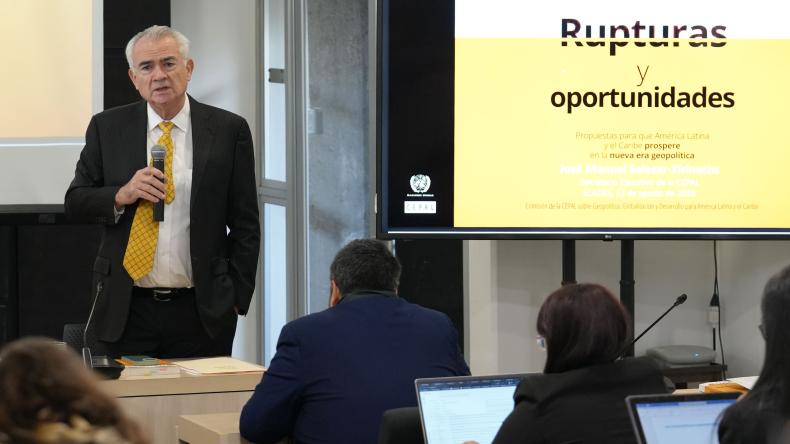
Within the framework of the training activities of the School of Latin American Development Studies (ELADES), the Executive Secretary of ECLAC, José Manuel Salazar-Xirinachs, delivered a class focused on the transformations of the world order and their implications for the region's development, under the title "Ruptures and Opportunities". The session drew on the main proposals of the report of the same name prepared by the Commission on Geopolitics, Globalization and Development for Latin America and the Caribbean, convened by ECLAC itself.
The Executive Secretary began with a diagnosis: the post-war system —built on multilateral institutions, shared rules and growing globalization— has given way to a phase marked by strategic rivalry, weaponized interdependence and fragmented governance. Within this framework, the Commission identified eight interrelated ruptures that are redefining the conditions under which countries compete, relate to one another and exercise influence.
These ruptures include the reconfiguration of globalization —from the predominance of economic efficiency to that of security—, the erosion of multilateralism and its shift towards smaller or "minilateral" arrangements, the move from unipolar hegemony to asymmetric multipolar competition structured by the rivalry between the United States and China, and the reconfiguration of soft power, an area in which China is progressively closing the gap with the United States. To these are added the decline of democracy and rising polarization, disinformation and the crisis of truth in the age of artificial intelligence, the backsliding on women's rights, gender equality and inclusion, and the end of the global consensus on climate.
Faced with this scenario, Salazar-Xirinachs argued, the region is not a passive actor: it possesses strategic assets that the world needs and that have been revalued in the new geopolitical context. The report organizes them into five categories: its natural resources —clean and fossil energy, food security, critical minerals such as lithium and copper, along with nearly half of the planet's terrestrial biodiversity and one third of the world's freshwater—; its productive, human and financial capacities; the region itself as an asset, with a market of more than 660 million people and a combined GDP of US$6.8 trillion; its political influence, as a zone of peace free of nuclear weapons and of interstate wars; and its soft power, grounded in cultural diversity, heritage and tourism.
The Executive Secretary stressed that turning these opportunities into development will not happen spontaneously: it requires clear strategies, strong institutions and effective governance. A large part of those strategies, he explained, corresponds to productive development policies capable of translating assets into growth, diversification, quality employment and higher productivity, illustrated in the class with two examples —the creative economy and biodiversity— which show how to move from exporting raw materials or poorly protected content towards higher value-added segments.
Governance, he insisted, is not a technocratic add-on but a precondition for development: it determines whether the region's assets become sources of resilience or of vulnerability. On this point, the Commission proposes four institutional improvement pathways: strengthening the capacity of the State, restoring institutional trust and legitimacy —in a region where only around 35% of the population expresses confidence in its government—, building minimum consensus in polarized settings, and confronting the expansion of organized crime, which accounts for close to one third of global homicides in the region with just 8% of the world's population.
The final two messages of the class turned to collective action. Salazar-Xirinachs held that the region does not need to agree on everything in order to cooperate: demanding full consensus tends to block entire initiatives, so the constructive alternative is to advance through flexible coalitions of interested countries, with clear objectives, timelines and responsibilities. Towards the world, the most appropriate strategy for expanding international agency is to broaden options, avoid rigid alignments and diversify alliances, building "variable-geometry coalitions" according to each issue. The reorganization of the world order, he warned, will not wait for the region: the absence of a strategy of its own does not lead to neutrality, but to accepting terms defined by others. The challenge, he concluded, is for Latin America and the Caribbean to stop being a "passive follower" and become an "architect of alternatives".
The class featured broad participation and interest on the part of the students, who posed numerous questions reflecting the geopolitical concerns and challenges specific to their respective countries, giving rise to a dialogue that enriched the session with the diverse realities of the region.
The session took place just days after the official launch of the report, on 4 August 2026, at a high-level event held at ECLAC headquarters and led by the Commission's co-chairs —former Presidents Michelle Bachelet, of Chile, and Iván Duque, of Colombia— together with the Executive Secretary. Details of that launch are available in the ECLAC press release.
The class on geopolitics and development is part of the Programme of Studies on Development Policies for Latin America and the Caribbean, which ELADES offers annually to some fifty young people from across the region.