

ECLAC

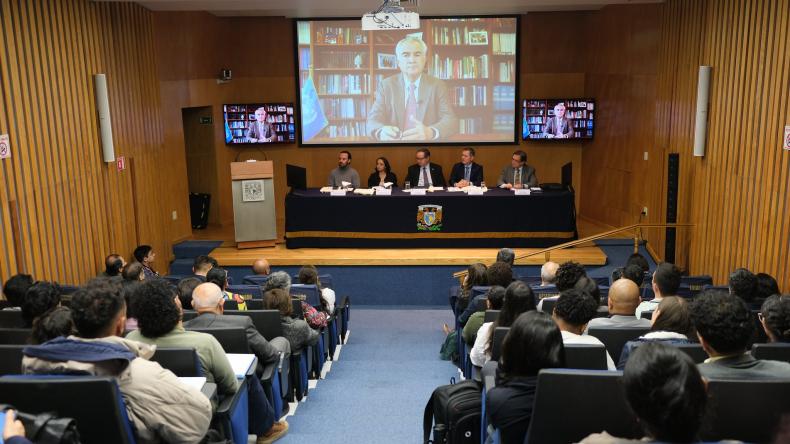
The Latin American School of Development Studies (ELADES) and the Latin American and Caribbean Institute for Economic and Social Planning (ILPES), both part of the Economic Commission for Latin America and the Caribbean (ECLAC), together with the University Program for Development Studies (PUED) of the National Autonomous University of Mexico (UNAM), launched the first edition of the Summer Course on Development Studies for Mexico and Central America on Monday, June 8, 2026.
The Summer Course is being held in person from June 8 to 26, 2026, over three weeks and totaling 48 instructional hours, at the facilities of UNAM’s Institute of Economic Research in Mexico City, Mexico.
The first cohort brings together 40 students from nine countries—Costa Rica, Cuba, El Salvador, Guatemala, Honduras, Mexico, Nicaragua, Panama, and the Dominican Republic—selected from more than 200 applicants who responded to the call for applications. The group stands out for its disciplinary diversity: participants come from fields as varied as economics, political science, international relations, sociology, environmental sciences, psychology, anthropology, and philosophy, among others.
The course was inaugurated by Leonardo Lomelí Vanegas, Rector of UNAM, who praised the joint initiative and encouraged students to make the most of the experience. The opening session also included a video message from José Manuel Salazar-Xirinachs, Executive Secretary of ECLAC, who welcomed the students and congratulated the organizers—the Latin American School of Development Studies (ELADES), the Latin American and Caribbean Institute for Economic and Social Planning (ILPES), both part of ECLAC, and UNAM’s University Program for Development Studies (PUED).
ECLAC’s highest-ranking official shared some of the key pillars of the organization’s current thinking and highlighted its increasingly robust educational offerings.
The opening ceremony also featured welcoming remarks by Sophie Ávila Foucat, Director of UNAM’s Institute of Economic Research, and an address by Enrique Provencio Durazo, Coordinator of PUED, who presented the background and expectations for the course. Also participating were Miguel Armando López Leyva, UNAM’s Humanities Coordinator, who reflected on the relationship between the humanities and development, and Jorge Mario Martínez-Piva, Director of ECLAC’s Subregional Headquarters in Mexico, who spoke about the historical contributions of the office over its 75 years of existence.
The Summer Course on Development Studies for Mexico and Central America is organized into six modules—comprehensive development, human development, social development, economic development, political development, and sustainable development—and is complemented by two thematic forums featuring specialists. Throughout the course, participants will explore both theoretical and empirical issues related to the development process of countries, territories, populations, and individuals, with a particular emphasis on the experiences of Mexico and Central America. Classes combine a conceptual introduction to each topic, a review of the available evidence for the region, and an analysis of the policies adopted to address major challenges.
Sessions are taught by ECLAC officials, UNAM academics, and distinguished guest professionals from other teaching and research institutions. Tuition and participation in the course are free of charge, and certification requires attendance at a minimum of 80 percent of the sessions.
Through this initiative, ECLAC and UNAM are making a joint contribution to the training of professionals with a comprehensive understanding of the region’s development challenges, paying particular attention to the specific circumstances of Mexico and Central America. The course provides a pluralistic space for thought that promotes discussion, reflection, and the exchange of ideas from an interdisciplinary perspective, in keeping with the historic mission of both institutions.
The Latin American School of Development Studies (ELADES) is an initiative of the Economic Commission for Latin America and the Caribbean (ECLAC) focused on research and teaching related to the development process in Latin America and the Caribbean. It serves as a pluralistic forum for reflection and the exchange of ideas on Latin American issues, drawing on contributions from ECLAC’s various divisions, headquarters, and offices, as well as advances at the frontier of research applied to development challenges.
ILPES is the leading entity within the ECLAC system for research, technical cooperation, and training in planning, economics, and public sector management for the development of Latin American and Caribbean countries. It fosters discussion and reflection on the challenges faced by the State in implementing development strategies. It contributes to national and subnational efforts aimed at improving the quality of public policies and strengthening institutional capacities.
In June 1951, the countries of Latin America and the Caribbean gathered at ECLAC’s fourth session, held in Mexico, agreed to establish ECLAC’s Subregional Headquarters in Mexico to work with the host country and the countries of Central America, as well as Cuba, Haiti, and the Dominican Republic. Since then, the office has generated knowledge on economic and social development and developed specialized public policy proposals for the countries it serves.