

ECLAC

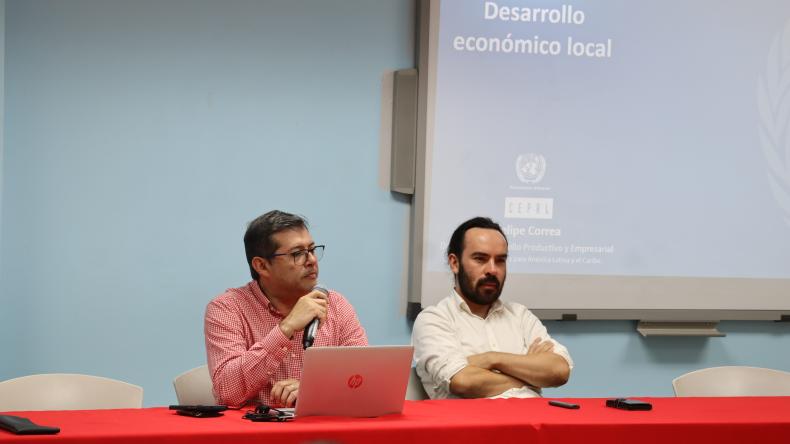
Within the framework of the academic outreach activities of the School of Latin American Development Studies (ELADES), economist Felipe Correa, professor at the School and staff member of ECLAC's Division of Production, Productivity and Management, delivered a presentation on local economic development at the Faculty of Social Sciences of the National University of Costa Rica (UNA), before students of the Economic and Social Planning programme, from the School of Planning and Social Promotion.
The speaker began by clarifying two concepts that are often confused. Local development, he explained, refers to the increase in the well-being of the population of a given territory and is multicausal in nature, since it involves dimensions such as education, health, income, the environment, community life and participation. Local economic development (LED), by contrast, refers specifically to the increase in the contribution that the economic dimension —income, consumption, food, housing and employment, among others— makes to that well-being. This distinction, he noted, allows LED to be understood not as an end in itself, but as a means to improve communities' quality of life.
Correa organized LED policies into four broad areas of action. The first, employment and human capital, brings together initiatives on training, job placement, employability and targeting of specific groups, such as women or older persons. The second, entrepreneurship and business development, covers the promotion of entrepreneurship, technical assistance and credit for MSMEs, business formalization, local public procurement and the streamlining of administrative procedures. The third, the local productive system, comprises territorial infrastructure, public productive services, tourism linked to heritage and culture, land-use planning and the circular economy. The fourth, institutional framework, brings together public-private roundtables, inter-institutional coordination, the promotion of associativity, the strengthening of local public capacities and the drafting of local economic development plans.
A central thread of the presentation was to show, drawing on evidence from the Colombian case, that local governments do far more than is usually visible in the field of economic development, and that their action goes beyond assistance-based approaches. In multilevel development policies, he indicated, municipalities tend to specialize in certain areas —entrepreneurship, training, tourism, associativity, rural policies and infrastructure—, complementing the work carried out at the national and subnational levels.
The professor also highlighted a finding of relevance for institutional design: more than the budget allocated, the decisive factor is the existence of offices or departments with high hierarchical standing within municipalities. In this regard, he presented data showing that, among the municipalities analysed, close to 38% had a dedicated LED directorate and 28% a shared one, while 22% had only a subdirectorate and 12% lacked a dedicated office. The hierarchy and the complexity of the institutional structure, he concluded, are key to sustaining effective local economic development policies.
The presentation featured broad participation and interest on the part of the students, whose questions gave rise to a dialogue on the challenges of planning and managing development at the local level, enriched by a comparative perspective across the realities of Chile, Colombia and Costa Rica.
The activity is part of the academic outreach work that ELADES and ECLAC carry out with universities across Latin America and the Caribbean, aimed at strengthening the training of new generations of professionals in the analysis and design of development policies for the region.